
Occupational Health and Safety

BDMS recognizes employee occupational health and safety as a key strategic priority in advancing the company’s governance and sustainability agenda (ESG), particularly under the Social (S) dimension. BDMS integrates occupational health and safety risk management such as burnout and workplace violence into its strategic policies to mitigate service quality risks and strengthen business continuity.
BDMS is committed to further strengthening its occupational health and safety management system by ensuring comprehensive prevention, monitoring, and continuous care. This approach links employee health risk management with relevant standards and fosters a systematic safety culture across the organization in order to provide a safe, high-quality, and sustainable working environment
Strategy and Management Approach

BDMS drives its occupational health and safety (OHS) management through a systematic approach that prioritizes prevention as the first line of action. The company integrates risk management into the daily operations of hospitals and affiliated companies to ensure comprehensive employee care that aligns with the specific working context of each unit.
The company implements a continuous management cycle encompassing risk assessment, the establishment of control measures, effective monitoring, and ongoing improvement. This process is guided by data on job characteristics, workplace conditions, and relevant hazards, enabling the company to prioritize risks and apply appropriate mitigation measures.
In addition, BDMS promotes active participation from both management and employees at all levels to strengthen a safety culture across the organization. Oversight and performance monitoring are conducted through relevant occupational health and safety indicators, with results regularly reviewed to enhance operational processes and reinforce a safe working environment that supports employee well-being in a sustainable manner.
Safety, Occupational Health, and Working Environment Policy
BDMS has established the Safety, Occupational Health, and Working Environment Policy as an operational framework for hospitals and affiliated companies to prevent hazards, reduce work-related risks, and promote a safe working environment that supports employee well-being.
For more details on Safety, Health, and Environment Policy. Please refer to
Safety, Occupational Health, and Working Environment Committee (SHE Committee)

BDMS has established the Safety, Occupational Health, and Working Environment Committee (SHE Committee) as a key mechanism to drive the company’s safety policies and measures in alignment with applicable laws, professional standards, and the operational context of all business groups.
The SHE Committee is responsible for establishing safety plans and measures, ensuring appropriate implementation of relevant laws and safety measures, monitoring performance, incidents, and adverse events, and promoting participation among personnel at all levels in reporting risks and providing recommendations for improvement. These efforts help foster a strong safety culture within the organization.
Occupational Health and Safety Risk Management
BDMS has established guidelines for assessing risks related to occupational health and safety, as well as the working environment, to comply with legal requirements. This is intended to determine management measures and health monitoring strategies for employees.
The process includes reviewing relevant information, conducting preliminary surveys, inspecting work areas, and analyzing results to identify health hazards and assess work-related risks. The assessment considers key factors such as the likelihood of hazards occurring, the likelihood of employee exposure, and the severity of potential hazards.
The results of the assessment are used to establish appropriate risk control measures, including the prevention, control, or mitigation of factors that may pose risks to employees. This process supports continuous improvement in occupational health and safety.
BDMS Employee Health and Safety Management
BDMS has implemented employee health and safety management through key measures and activities that cover health promotion, risk prevention, and comprehensive employee safety management. These include health promotion and disease prevention, risk-based health surveillance, vaccination for healthcare personnel, ergonomics prevention, mental health support, and workplace violence prevention.
Work - Related Illness Symptoms Procedure
When an occupational medicine doctor identifies and diagnoses a work-related illness, BDMS manages the case systematically. This begins with a root-cause investigation and an assessment of workplace risk factors to identify sources of exposure and establish appropriate control measures, alongside clinical care for the employee.
The company provides health advice and guidance on appropriate practices and, where necessary, considers job modification or workplace adjustments to reduce exposure and prevent progression from an early stage. The company also conducts continuous follow-up to mitigate severity and prevent recurrence of work-related illnesses.
Contractor and Third-Party Safety Training and Orientation

BDMS places strong emphasis on compliance with occupational health and safety requirements for contractors and third parties performing work within BDMS network hospitals and subsidiaries. This includes compliance with applicable legal requirements, as well as site-specific rules and procedures to prevent accidents and reduce risks arising from work activities.
Prior to commencing work, all contractors are required to acknowledge and comply with the safety requirements, rules, and procedures of the relevant worksite. Contractors and third parties must also complete a safety orientation or briefing relevant to the work area and job scope before entering the worksite. For work in high-risk areas, prior approval from the responsible supervisor and safety officer is required. Safety personnel provide guidance and monitor work activities to ensure compliance with safety standards.
Occupational Health and Safety Initiatives
BDMS requires hospitals and affiliated companies to continuously implement occupational health and safety initiatives in order to strengthen a safety culture aligned with the BDMS Safety, Occupational Health, and Working Environment Policy. The company also integrates OHS practices into daily operations and systematic organizational risk management.
1. Emergency Preparedness and Response Initiative
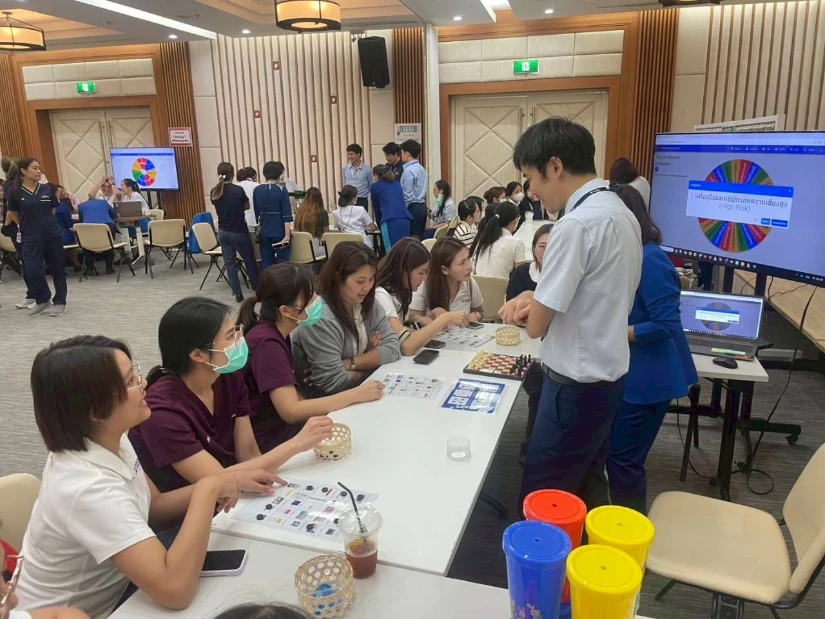
BDMS places strong importance on emergency preparedness and response to protect the lives of service recipients and employees, while ensuring continuity of healthcare services. The company enhances staff capability, operational systems, and coordination with relevant agencies through scenario-based emergency drills and ongoing practical knowledge development.
Bangkok Hospital Chiang Mai implemented the Facility Management for All Staff program, a hands-on training initiative in Facility Management & Safety based on the Joint Commission International (JCI) Facility Management & Safety (FMS) standards. The program achieved 100% attendance among designated participants, reflecting systematic engagement and strong leadership commitment to facility safety and preparedness.
2. Workplace Environment Enhancement and Environmental Risk Control Initiative
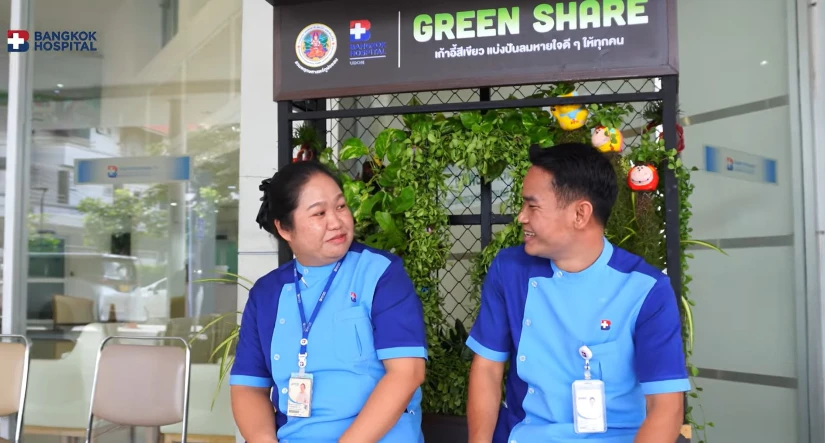
BDMS implements initiatives to improve the working environment and reduce risks from environmental factors within healthcare facilities. The company emphasizes the monitoring, surveillance, and management of conditions that may affect employees and customers, such as indoor air quality, particulate matter, and building-related gases.
Bangkok Hospital Udon implemented the Green Wall, Green Share & Smart Air Quality System Program through the installation of a smart air quality monitoring and management system, together with the development of indoor green spaces and workplace green areas. The results showed that satisfaction with air quality increased from 59% to 91%, average PM2.5 levels decreased by 30.7% within three months, and the initiative contributed to carbon dioxide absorption of approximately 624 kilograms per year.
3. Ergonomics-Based Injury and Occupational Disease Prevention Initiative
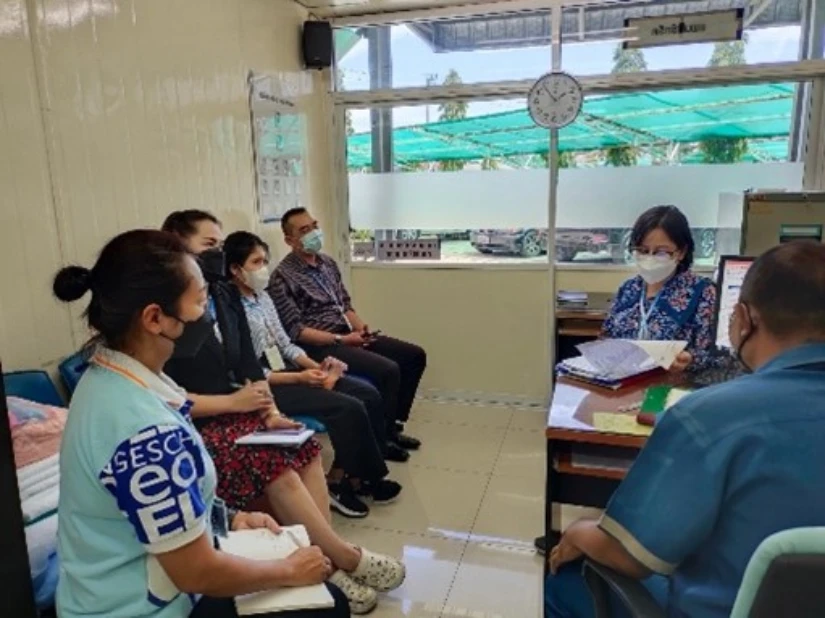
The company places strong importance on preventing workplace injuries and occupational illnesses, particularly risks associated with lifting, carrying, transferring heavy loads, or maintaining improper postures over extended periods. Such factors may contribute to musculoskeletal disorders and increase the likelihood of accidents in operational areas. The company therefore encourages hospitals and affiliated companies to implement systematic hazard control and risk reduction measures through workflow improvement, the use of assistive devices, and workplace design adjustments. These efforts aim to continuously enhance ergonomics standards and workplace safety.
Paolo Hospital Samut Prakan implemented the Mini Crane project to prevent injuries related to laundry handling and textile transportation. The hospital introduced a Mini Crane lifting device to replace manual lifting. Post-implementation evaluation showed that user satisfaction with the Mini Crane was rated at a high level, representing 100% satisfaction. During the monitoring period, no lifting-related accidents were reported following installation.