
Circular Economy
At present, climate change and environmental problems have become more severe; therefore, many organizations and people must review and change their mindset regarding production methods, consumption, and services. The circular economy is one solution that can solve these challenges while enabling economic growth, minimizing waste management expenditures as well as ensuring adequate resources. Nonetheless, population growth can lessen the need to rely on key raw materials from abroad, minimizing CO2 emission and waste while creating new production innovation which in turn, helps generate more added value. BDMS determines the directions and sustainability goals for 2050 by increasing the ratio of non-hazardous and reusable waste by 50%
Management Approach
BDMS values resource use efficiency while minimizing loss and emphasizing recycling throughout the supply chain under the circular economy principle. Simultaneously, BDMS raises awareness and encourages consumer behavior changes following the 5Rs principle (reduce, reuse, recycle, repair, and reject).
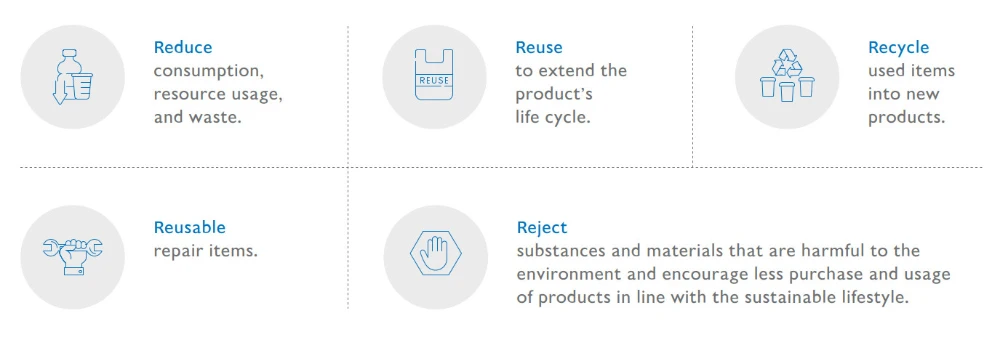
Waste Management guidelines are as follows:
- Garbage containers must have characteristics suitable for use. There are specific colors to accommodate each type of waste or other messages or symbols that clearly indicate that type of waste may be specified on the waste container instead.
- Blue for general waste
- Green for organic waste
- Yellow for recycled waste
- Orange or Gray for toxic or hazardous waste
- Red for infectious waste
- Setting up garbage containers in the hospital/company area
The responsible department provides trash cans set in different areas around the hospital/company which have sufficient clear identification signs appropriate to the amount of waste that will be generated.
- Hospitals should set up containers to receive at least 3 types of waste in various areas: general waste, recycled waste, and infectious waste.
- Company should set up containers to receive at least 2 items of waste in various areas: general waste and recycled waste.
- Hospital/company garbage house must be separated into 5 types according to item 1.
- Waste management methods Executives and employees at all levels are responsible for separating waste and managing hazardous waste appropriately. Waste disposal guidelines for hospitals/companies can be considered as appropriate in each area according to established practices and laws.
Waste measurement and audit.
- The hospital/company organizes random inspections of waste disposal regularly at waste disposal points at least twice a month to encourage participation in correct waste sorting.
- BDMS CSD will review the quantity of waste (measured in kilograms) from each category of hospitals and companies every 3 months.
Employee Engagement in Waste Reduction
BDMS places strong emphasis on employee participation and behavioral change to reduce operational waste. The organization implements various educational activities and projects to promote waste management awareness and encourages the creation of innovations, practices, or guidelines that support waste reduction. Key initiatives include:
- Raising employee awareness of the environmental impacts of waste and the importance of environmental conservation. This fosters a sense of responsibility and promotes correct waste disposal behavior—both at the workplace and at home to reduce waste generation, disposal costs, and environmental harm.
- Ensuring that employees understand the importance of proper waste segregation based on waste types to enable appropriate disposal and reuse.
- Continuously adopting innovative technologies, equipment, and knowledge to reduce, recycle, and reuse waste. Employees are encouraged to share ideas and propose projects, activities, or technological innovations related to waste management.
- Sustaining the waste separation initiative across all BDMS entities.
- Organizing annual outreach activities and events to educate communities and the general public on effective waste management practices.
The ratio of non-hazardous waste is utilized