
Supply Chain Management
Supply Chain Management Strategy and Sustainability Integration
Governance and Management Structure
BDMS manages its supply chain under a comprehensive governance framework encompassing the formulation of responsible procurement strategies and policies, risk management, and the enhancement of business continuity throughout the supply chain. Environmental, social, and governance considerations are integrated into procurement and supplier management processes to support efficient, transparent, and sustainable business operations.
The BDMS Supply Chain and Resource Management Committee is responsible for setting strategic direction and operational guidelines, overseeing the implementation of strategies and policies, and monitoring, reviewing, and reporting supply chain performance and material risks to the Board of Directors. The Committee also oversees and ensures the continuous development and improvement of responsible supply chain management processes in accordance with the principles of transparency, fairness, and accountability to all stakeholder groups.
The BDMS Supply Chain and Resource Management Committee oversees the identification, assessment, prioritization, and monitoring of risks throughout the supply chain. It also establishes preventive and mitigating measures and reports on risk status and the effectiveness of risk management measures to the Board of Directors, thereby facilitating timely decision-making and responses to emerging situations. Particular attention is given to risks that may affect the quality and safety of products and services; the availability of medicines, medical supplies, and medical equipment; and the continuity of healthcare services. BDMS also enhances suppliers’ capabilities to enable them to grow alongside the Group, in compliance with applicable laws, national guidelines, and relevant international standards.
Management Approach
Supply Chain Management Strategy
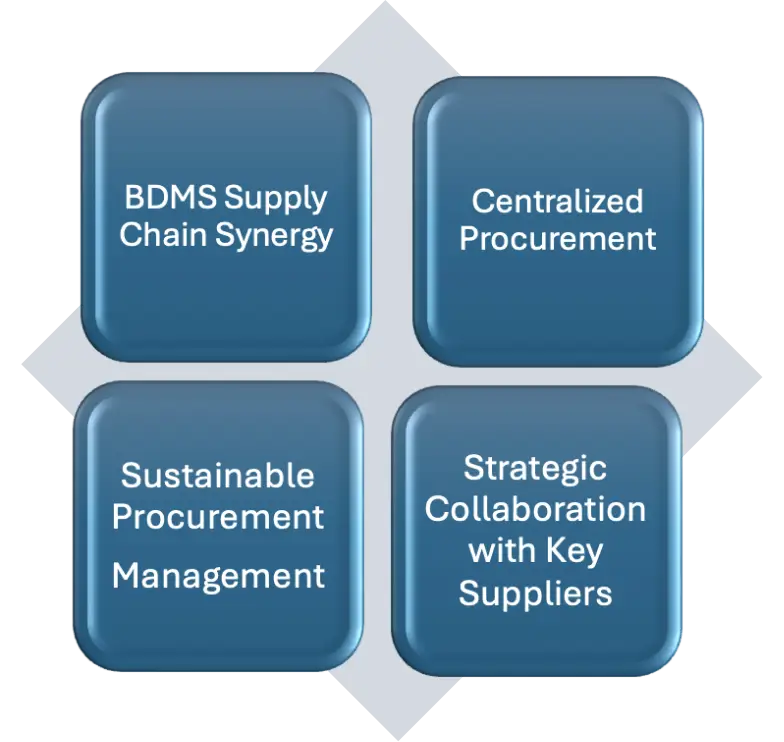
The organization has established the “BDMS Supply Chain Synergy” strategy as a key framework for enhancing supply chain efficiency and sustainability through collaborative integration across its hospital network and business partners. The strategy encompasses procurement, warehousing, distribution, and inventory management processes in a systematic manner to ensure the availability, accuracy, and adequacy of medical resources in alignment with patient and service demands. This contributes to improved quality of healthcare services, optimized resource utilization, and strengthened supply chain resilience.
BDMS also implements a centralized procurement approach to enhance governance efficiency, strengthen transparency, and support operations in accordance with international standards. The integration of data across all business units enables the organization to analyze trends and undertake strategic planning for the continuous improvement of procurement processes.
In addition, the organization incorporates sustainable procurement principles into supplier selection and evaluation processes by taking into consideration human rights, business ethics, legal compliance, and the management of environmental and social impacts. This ensures that operations throughout the supply chain are aligned with the Supplier Code of Conduct and responsible business practices.
At the same time, BDMS is committed to strengthening strategic relationships with critical suppliers through knowledge sharing, joint capability development, and the promotion of high-quality and environmentally friendly products and services. These collaborative efforts contribute to the development of a sustainable value chain, mitigation of supply chain risks, and enhancement of the long-term competitiveness of both the organization and Thailand’s healthcare system.
Ethics and Supplier Practices
BDMS Supplier Code of Conduct
BDMS reviewed and updated its Supplier Code of Conduct to establish principles, guidelines, and expectations for suppliers conducting business with BDMS in an ethical, transparent, fair, and accountable manner. The Code is communicated to suppliers to foster understanding and support effective implementation. The revised Code covers six key areas: (1) business ethics; (2) quality and standards of products and services, and responsible sourcing; (3) labor practices and human rights; (4) occupational health, safety, and the working environment; (5) responsibility to communities and society; and (6) environmental responsibility.
The review strengthened BDMS’s approach to managing environmental, social, and governance (ESG) risks throughout its supply chain. The revised Code places greater emphasis on the quality and safety of products and services, traceability, responsible sourcing, personal data protection and cybersecurity, financial transparency, and anti-corruption. It also encourages suppliers to cascade these practices to their employees, subcontractors, and business partners, supporting continuous improvement and creating shared value for stakeholders both within and outside the organization.
BDMS monitors and evaluates compliance with the Supplier Code of Conduct through appropriate audit and assessment processes. Suppliers are required to cooperate and provide relevant information or supporting evidence upon request. Where non-compliance is identified, suppliers must take corrective action within the specified timeframe. Depending on the circumstances and severity of the non-compliance, BDMS may establish and monitor a corrective action plan, temporarily suspend business activities, or remove the supplier from the Approved Vendor List (AVL) within its procurement system. These measures aim to collectively raise operational standards, foster a transparent and resilient supply chain, and drive responsible growth.
Scope of the BDMS Supplier Code of Conduct
- Business Ethics
- Quality and Standards of Products and Services, and Responsible Sourcing
- Labor Practices and Human Rights
- Occupational Health, Safety and Working Conditions
- Community and Social Responsibility
- Environmental Responsibility
Sustainable Supply Chain Management Approach
-
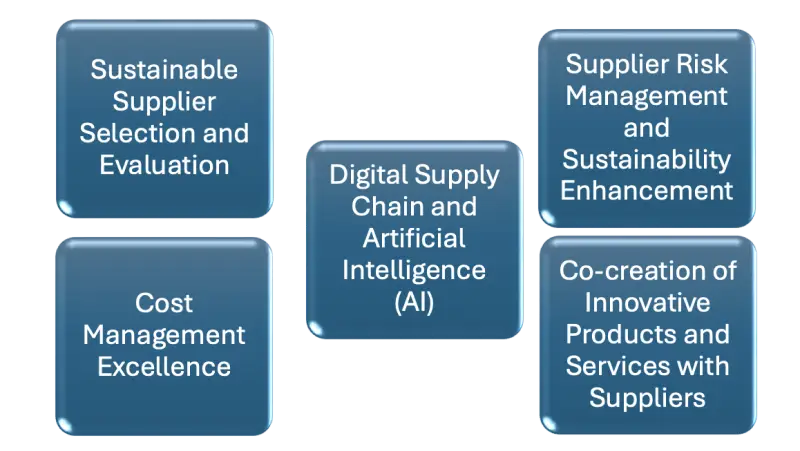
Sustainable Supplier Selection and Evaluation
The company conducts procurement of goods and services from both new and existing suppliers through a structured process of supplier sourcing, selection, and evaluation in accordance with the company's sustainability criteria and Supplier Code of Conduct, including the registration of approved suppliers under the Approved Vendor List (AVL).
-
Supplier Risk Management and Sustainability Enhancement
The company manages supplier sustainability risks in alignment with the Supplier Code of Conduct through continuous monitoring and performance evaluation, including supplier audits and collaborative improvement programs with suppliers.
-
Digital Supply Chain and Artificial Intelligence (AI)
The company enhances procurement operations through digital platforms and the application of artificial intelligence (AI) to improve operational efficiency, strengthen data analytics capabilities, and maintain long-term competitive advantage.
-
Cost Management Excellence
Effective cost control is implemented throughout the procurement process across all categories of goods and services to improve overall operational efficiency.
-
Co-creation of Innovative Products and Services with Suppliers
The company supports suppliers in developing new innovations and creating shared value, while promoting environmentally friendly procurement practices (Green Procurement) to integrate sustainability throughout the entire supply chain.
BDMS Supplier Selection and Evaluation
Supplier Selection
BDMS procures products and services from new and existing suppliers registered in the Approved Vendor List (AVL). All suppliers must undergo a selection and evaluation process based on the sustainability criteria in line with the BDMS Supplier Code of Conduct. Suppliers are excluded from contracting if they cannot achieve minimum ESG requirements within a set timeframe. Suppliers with better ESG performance are preferred by applying a minimum weight to ESG criteria in supplier selection and contract awarding. The suppliers are then categorized based on relevance using a supplier system related to BDMS business operations. When assessing the reference documents, BDMS evaluates by considering 2 factors:
Supplier Selection and Sustainability Assessment Criteria
-
Price and quality of products and services: 90%
Assessment criteria include:
-
Product and service quality
-
Pricing and financial stability
-
Customer service
-
Delivery performance
-
Technology and innovation capabilities
-
Manufacturing standards and relevant certifications, such as FDA approval, GMP, PIC/S, ISO 9001, ISO 13485, TISI, or CE Mark certification.
-
-
Sustainability Performance 10%
Governance Impact
e.g., compliance with applicable requirements, non-disclosure of information without consent, and the existence of a Supplier Code of Conduct to support sustainable procurement practices.
Social Impact
e.g., compliance with labor standards and human rights principles, and certification for occupational health and safety management systems such as ISO 45001:2018 or OHSAS 18001.
Environmental Impact
e.g., implementation of measures to reduce environmental impacts, certification of environmental management systems such as ISO 14001:2026 or Green Procurement, as well as the use of environmentally certified products, such as paper and employee uniforms made from recycled materials, and systematic environmental management practices.
Identification of Critical Suppliers
The Company has established a supplier segmentation and prioritization process, with particular emphasis on identifying critical direct suppliers based on their level of business relevance to the organization, together with the assessment of suppliers’ sustainability risks. This process is conducted with reference to relevant documents and supporting information.
The identification of critical direct suppliers is based on two key considerations:
-
Sustainability Risk Management of Suppliers
The Company manages sustainability-related risks associated with suppliers across governance and economic, social, and environmental dimensions in alignment with the Company's policies. Supplier risk assessments are conducted based on the following factors:

-
Business-Related Factors Management
The Company has established criteria and processes for supplier selection and prioritization based on the significance of product or service categories to business operations. This enables the Company to effectively manage suppliers that are critical to operational continuity and strategic business objectives.
| Critical Supplier by Product or Service Category | ||
|---|---|---|
|
Strategy Level Products or services that are critical and/or essential to long-term business operations, such as controlled medicines and medical devices that pose risks to patients. |
Critical Level Products or services that are essential, highly specific, and play a key role in core operations related to patient safety and patient care, such as pharmaceuticals and medical supplies. |
Important Level Products or services that support the operations of healthcare professionals, such as information technology solutions and construction services. |
Business-Related Factors Management
- Suppliers providing products and services to 10 or more hospitals
- Suppliers accounting for 80% of annual spending volume
- Suppliers of products and services for which no substitutes are available
- Suppliers engaged in collaborative innovation development
BDMS continuously monitors suppliers’ sustainability performance. The combined assessment of these two factors enables the organization to identify critical suppliers and develop appropriate long-term approaches for sustainable supply chain management and administration.
Supplier Screening Results 2025
| Supplier Selection | Unit | Number of Supplier |
|---|---|---|
| Number of Tier 1 Supplier | Supplier / Company | 4,727 |
| Number of Critical Tier 1 Supplier | Supplier / Company | 170 |
| Total Product and Service Procurement Value | Million THB | 25,011 |
| Total Product and Service Procurement Value by Critical Tier 1 Supplier | Million THB | 8,339 |
| Percentage of Procurement Value by Critical Tier 1 Supplier | % | 33% |
| Number of Critical Non Tier 1 Supplier | Supplier / Company | 55 |
| Number of Critical Tier 1 Supplier and Critical Non Tier 1 Supplier | Supplier / Company | 225 |
Supplier Assessment
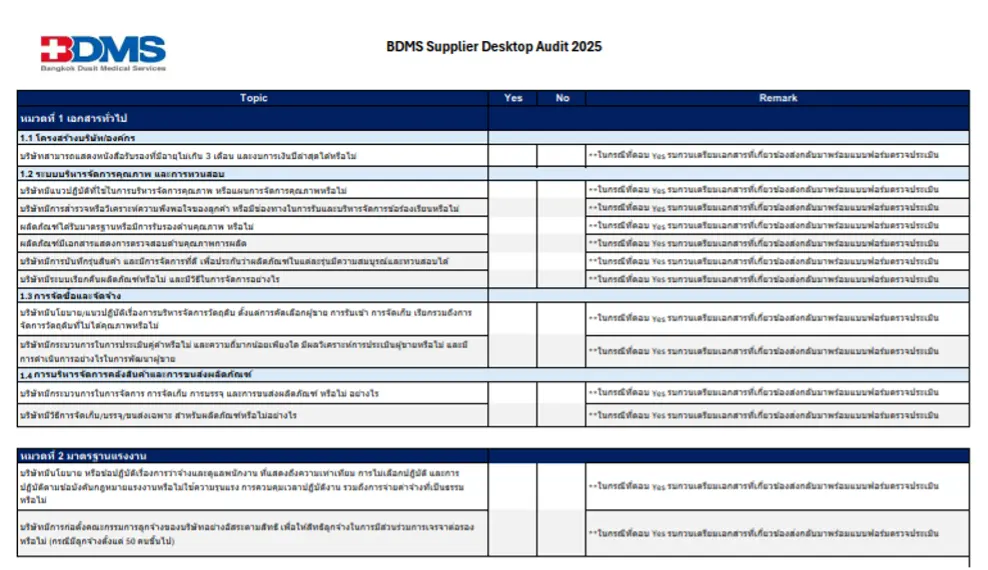
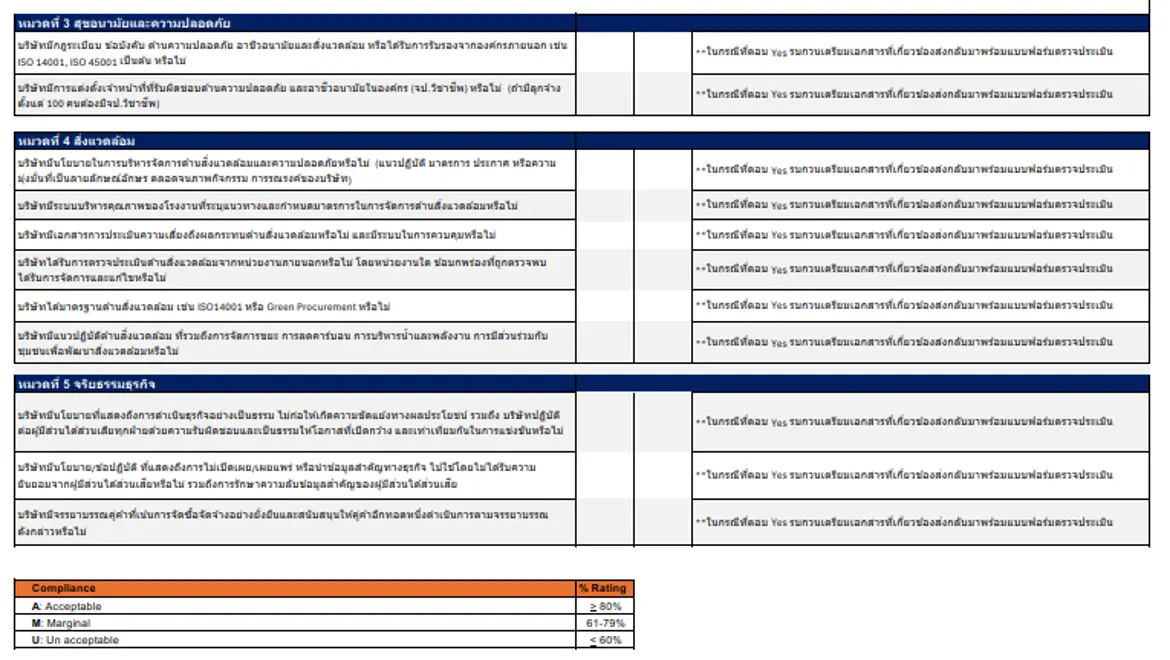
BDMS conducts Supplier Risk Assessments through a systematic evidence-based verification process in accordance with the internationally recognized Sedex Members Ethical Trade Audit (SMETA) standard. The assessment covers key areas including quality, delivery performance, technology and innovation, good corporate governance, business ethics, social responsibility, occupational health and safety, environmental performance, and compliance with the BDMS Supplier Code of Conduct to ensure alignment with the Company’s sustainability standards and development guidelines.
The assessment process covers key sustainability-related topics, including:
-
Quality management systems and verification processes
-
Procurement and contracting practices
-
Warehouse management and product transportation management
-
Labor standards
-
Health and safety
-
Environmental management
-
Business ethics
Supplier Risk Assessment
BDMS evaluates the performance of its key suppliers based on criteria established by the organization. Suppliers are rated from Grade A to Grade F, with the assessment results used to support risk management, performance monitoring, and appropriate supplier capability development.
BDMS prioritizes the development of suppliers requiring improvement, including suppliers rated as Critical Low Performers (Grade F) and High-Risk Performers (Grade D). These suppliers are required to complete a Self-Assessment and submit a Corrective Action Plan (CAP) within 30 days of receiving their assessment results.
During the latest assessment cycle, one supplier was identified as requiring improvement and was rated at Level D. No suppliers received a Level F rating. Key areas for improvement included service quality, delivery reliability, technological capabilities, and sustainability practices.
Following the assessment, BDMS Supply Chain Solution collaborates with the suppliers to establish improvement measures and targets, closely monitoring their progress over a one-year period. Follow-up assessments are also conducted to evaluate the effectiveness of the improvement plans, while guidance is provided to enhance suppliers’ environmental, social, and governance (ESG) performance in alignment with BDMS’s procurement standards and Supplier Code of Conduct. This process helps mitigate supply chain risks, strengthen supplier collaboration, and support shared sustainable growth throughout the value chain.
On-Site Supplier Assessment
BDMS Supply Chain Solution, acting as a second-party assessor, conducts on-site assessments based on suppliers’ Self-Assessment results to identify and evaluate actual and potential significant risks and adverse impacts throughout the supply chain. In 2025, the Company conducted on-site assessments of two suppliers.
The Company prioritizes Tier 1 critical suppliers, particularly those classified as Critical Low Performers (Grade F) and High-Risk Performers (Grade D), with the aim of systematically improving their performance in line with their Corrective Action Plans (CAPs).
In addition, BDMS Supply Chain Solution collaborates with suppliers to establish improvement measures, monitor performance, and provide ongoing guidance. These efforts are intended to mitigate potential impacts, enhance environmental, social, and governance (ESG) standards, and foster concrete and continuous collaboration in advancing sustainable business practices throughout the supply chain and value chain.


In 2025, BDMS conducted supplier evaluations, with the following results:
| Supplier Evaluation | Unit | Number of Supplier | Target 2025 |
|---|---|---|---|
| Number of Tier 1 Supplier | Supplier / Company | 4,727 | |
| Number of Critical Tier 1 Supplier | Supplier / Company | 170 | |
| Number of Critical Non Tier 1 Supplier | Supplier / Company | 55 | |
| Number of Critical Tier 1 Supplier and Critical Non Tier 1 Supplier | Supplier / Company | 225 | |
| Total number of suppliers assessed via desk assessments/on-site assessments | Supplier / Company | 225 | |
| Percentage of evaluated critical suppliers | % | 100 | 100% |
| Total number of suppliers supported with development measures | Supplier / Company | 225 | |
| Percentage of suppliers supported with development measures | % | 100 | 100% |
| Number of suppliers identified with actual or potential significant negative impacts (Score D) | Supplier / Company | 1 | 100% |
| Number of suppliers identified with actual or potential significant negative impacts (Score F) | Supplier / Company | 0 | 100% |
| Percentage of suppliers with actual or potential significant negative impacts and corrective action plans | % | 100 | |
| Number of suppliers with actual or potential significant negative impacts that were terminated | Supplier / Company | 0 | |
| Total number of suppliers supported and provided with corrective action plans | Supplier / Company | 1 | 100% |
| Percentage of evaluated suppliers with actual or potential significant negative impacts that received support and corrective action plans | % | 100 |
In 2025, the Company identified 170 Critical Tier 1 Suppliers and 55 Critical Non Tier 1 Supplier, totaling 225 Unique Significant Suppliers. The Company also conducts regular annual reviews and assessments to ensure that the identification of significant suppliers remains accurate, appropriate, and reflective of the current supply chain landscape.
Key Issues Identified from Supplier Assessments
The significant issues identified from the supplier assessment process include:
-
Service performance
-
Delivery reliability
-
Technology capability
-
Sustainability practices
Examples of Significant Actual or Potential Adverse Impacts and Sustainability Risk Management Measures (Corrective Action Plan: CAP) in 2025
| Risk Description | Mitigation Plan | Monitoring | Outcome Indicators |
|---|---|---|---|
| Raw Material Shortage | - Diversify sourcing channels (Dual Sourcing) - Maintain strategic stock reserves - Develop local suppliers |
- Monitor inventory levels weekly - Conduct quarterly supplier risk assessments - Review delivery lead times |
- Dependency on a single supplier not exceeding 50% - Zero stock-out incidents |
| Non-compliance with Laws and Standards | - Prepare for GMP audits - Conduct internal audits - Provide continuous QA/QC training |
- Monitor audit findings and CAPA implementation - Review monthly compliance checklists - Monitor updates to regulatory requirements |
- 100% GMP compliance - No major audit findings |
| Price and Cost Volatility | - Establish long-term supplier agreements - Diversify sourcing channels - Hedge foreign exchange risks - Monitor raw material market trends |
- Conduct monthly procurement cost analysis - Monitor market price indices and FX rates - Compare actual costs against budget |
- Cost increases not exceeding 5% of budget - Improved cost forecasting accuracy |
| Excessive Supplier Dependency | - Increase supplier diversification - Develop alternative suppliers - Maintain buffer stock levels |
- Conduct quarterly supplier performance evaluations - Monitor supplier concentration ratio - Review OTIF (On-Time In-Full) performance |
- Dependency on Top 5 suppliers below 50% - OTIF rate above 95% |
| Warehouse and Distribution Risks | - Improve demand forecasting systems - Enhance inventory visibility integration - Utilize IoT for cold chain monitoring - Audit logistics service providers |
- Review stock coverage weekly - Monitor cold chain temperature in real time - Evaluate logistics providers' SLA performance |
- Stock-out rate below 2% - No cold chain temperature violations |
| Customer Experience and Satisfaction | - Establish standardized service SOPs - Implement QA processes for telemedicine - Integrate omni-channel systems - Conduct customer satisfaction and NPS surveys |
- Analyze customer complaints - Monitor monthly NPS/CSAT survey results - Review service SLAs |
- NPS ≥ 75 - CSAT ≥ 85% |
| Cybersecurity and Personal Data Protection | - Establish and implement IT Governance - Implement Data Encryption - Conduct Penetration Testing - Obtain Cyber Insurance. |
- Monitor and respond to security incidents - Review Vulnerability Assessment results - Audit PDPA compliance |
- No major data breach incidents. -Achieve 100% PDPA compliance. |