
Corporate Governance

BDMS remains fully committed to operating under the principles of Good Corporate Governance, characterized by responsibility, ethical conduct, fairness, transparency and accountability. The company believes that a sound governance system serves as a critical mechanism to strengthen relationships among the Board of Directors, management, employees, shareholders and stakeholders, enabling the company to deliver appropriate and sustainable value to shareholders while responsibly addressing the interests of all stakeholder groups and reinforcing its position as a leading and sustainable healthcare provider.
In an increasingly complex and rapidly changing business environment, BDMS places strong emphasis on Board diversity by taking into account a broad range of perspectives, professional experiences and industry-specific expertise, which supports effective oversight, strategic guidance and well-informed decision making aligned with the company’s business context and long-term strategic direction.
Strategy and Management Approach

BDMS recognizes its roles, duties and responsibilities in conducting business under the principles of good corporate governance. The company believes that good corporate governance is a fundamental foundation for defining the structure and relationships among shareholders, the Board of Directors, management and all stakeholder groups. This approach enhances the company’s competitiveness and creates long-term value for shareholders, while giving due consideration to the interests of all stakeholders, thereby supporting the company’s continuous and sustainable growth.
Corporate Governance Policy
The company conducts its business with transparency, accountability and a commitment to building trust among stakeholders to support stable and sustainable long-term organizational growth. Accordingly, the Board of Directors has established a Corporate Governance Policy as a clear governance framework to serve as a common guideline for the Board of Directors, management and employees at all levels across the Group.
This policy and governance framework are designed in alignment with relevant laws, regulations, requirements and principles of good corporate governance at both national and international levels and comprise the following 5 key principles:
- Section 1: Sustainable Value Creation
- Section 2: Roles and Responsibilities of the Board of Directors
- Section 3: Rights of Shareholders and Fair and Equitable Treatment of Shareholders
- Section 4: Policy and Treatment of Stakeholders
- Section 5: Information Disclosure and Transparency
For more information , please refer to Corporate Governance Policy
Corporate Governance Structure
BDMS has established a corporate governance structure that clearly defines the roles and responsibilities of the Board of Directors, subcommittees, management and internal governance units. This structure supports the company’s operations in compliance with applicable laws, regulations, shareholders’ resolutions and principles of good corporate governance.
The Board of Directors has appointed 5 subcommittees, namely:
- Audit Committee
- Nomination and Remuneration Committee
- Executive Committee
- Risk Management Committee
- Corporate Governance and Sustainability Committee
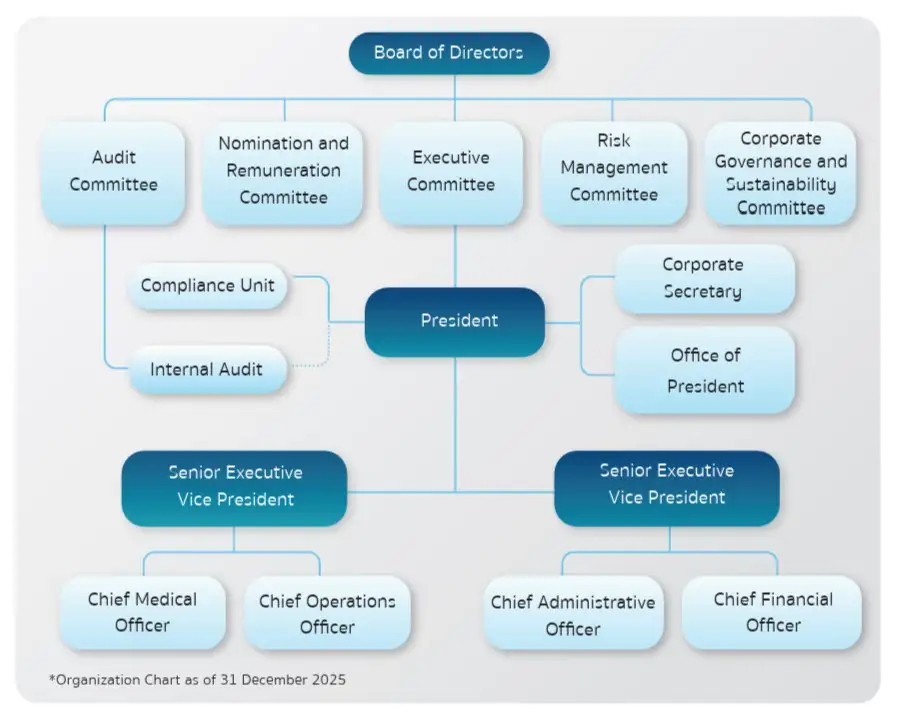
These subcommittees are responsible for formulating and reviewing policies and monitoring performance within their respective scopes of responsibility. Policies and operational guidelines are communicated through senior management to ensure effective implementation and continuous performance monitoring across all levels of the organization. The subcommittees also support the establishment of operational policies, internal control systems, and corporate governance practices that are appropriate and aligned with relevant laws, regulations, and international standards.
Promoting a Strong Corporate Governance Culture

The company encourages directors, medical professionals, and employees to build awareness and understanding of the principles of good corporate governance, while continuously driving the communication of relevant policies and practices, such as the Corporate Governance Policy, Fraud Prevention and Anti-corruption Policy, Code of Conduct and Whistleblower Policy. These efforts aim to ensure transparent and accountable operations, reduce reputational risks, and strengthen trust among stakeholders, including patients, service recipients, shareholders, business partners, and society.
The company also emphasizes comprehensive policy communication to ensure that personnel clearly understand expected and prohibited conduct, as well as associated impacts and disciplinary measures. This helps reduce the risk of corruption, abuse of authority, and conflicts of interest.
As a result of these efforts, the company received an “Excellent” Corporate Governance Rating (5 stars) for 2025 under the Corporate Governance Report of Thai Listed Companies (CGR) conducted by the Thai Institute of Directors (IOD).
Lobbying & Trade Associations – Climate Alignment
BDMS is committed to supporting the Paris Agreement and its net-zero target through the continuous improvement of environmental management systems and the development of activities that promote the efficient use of natural resources. BDMS considers networking and participating in memberships with organizations that promote the Paris Agreement as a valuable way to reinforce the net-zero target on a broader scale. The Company continues to support trade associations that play a role in addressing climate change and participates in environmental activities together with environmental organizations in Thailand, in addition to contributing to enhanced healthcare access for underprivileged communities in collaboration with various foundations.
In 2025, BDMS reviewed and assessed the trade associations of which it is a member, to identify those with climate-related objectives and to align them with the net-zero target of the Paris Agreement, as follows:
| Organization Name | BDMS's Position | Organization's Objectives and Activities | Alignment Status | Action Taken |
| Thai Chamber of Commerce | Membership | Acts as a host to organize meetings presenting the progress of the Bio-Circular-Green Economy (BCG) and ESG initiatives towards sustainability, aligned with the goal of achieving Carbon Neutrality by 2050 and Net Zero Emissions by 2065. | Partially aligned | Continue to maintain support for the trade association |
| Thailand Carbon Neutral Network (TCNN) | Membership | Fosters collaboration between the private sector, government, and local/community sectors to reduce greenhouse gas emissions, supporting sustainable development within a society that prioritizes climate-friendly practices, in alignment with the objectives of the Paris Agreement. Develops a knowledge-exchange platform among network organizations to manage and reduce greenhouse gas emissions, with the goal of achieving corporate-level carbon neutrality. | Aligned | Continue to maintain support for the trade association |
Anti-Corruption Practices and Complaint Management
Management Approach
BDMS conducts its business in accordance with the principles of good corporate governance, emphasizing transparency, fairness, ethical conduct, and accountability. The Company maintains a zero-tolerance stance toward all forms of corruption, as stipulated in its Code of Conduct.
In 2025,å the Company reviewed and updated its Fraud Prevention and Anti-corruption Policy to ensure alignment with applicable laws, regulations, and business-related requirements, as well as internationally recognized standards. The policy establishes reporting and complaint channels for violations of laws, unethical conduct, or activities that may constitute corruption.
The Company has implemented whistleblower protection measures and appropriate remediation mechanisms to mitigate potential adverse impacts. In parallel, various training programs and communication activities are conducted to enhance knowledge, understanding, and awareness among employees at all levels, as well as external stakeholders, regarding the Company’s anti-corruption policy. Clear whistleblower protection mechanisms have been established, together with strict disciplinary actions against individuals who engage in inappropriate behavior, intimidation, harassment, or discriminatory treatment toward whistleblowers.
The policy applies to the Board of Directors, executives, and employees at all levels and serves as a framework for preventing, mitigating, and addressing corruption risks within the organization. The Board of Directors actively promotes and communicates the policy to both internal and external stakeholders through appropriate communication channels.
BDMS Fraud Prevention and Anti-Corruption Policy
Prevention of Bribery and Corruption
BDMS has established the Fraud Prevention and Anti-Corruption Policy to provide an operational framework and set out measures to prevent and combat all forms of fraud and corruption. The Policy defines the expectations, roles, duties, and responsibilities of directors, executives, and employees at all levels across the BDMS Group and its subsidiaries.
The operational guidelines cover fraud and corruption prevention measures, as well as complaint and whistleblowing mechanisms. The key provisions are as follows:
- Guidelines for Preventing Bribery and Corruption
BDMS has established relevant guidelines and measures, including:
- Procurement regulations and contractual requirements, together with processes subject to review by the Internal Audit function;
- Guidelines governing the giving and receiving of gifts, political contributions and support, charitable donations, and sponsorships; and
- Risk control and prevention measures relating to charitable donations and contributions for public benefit. These measures ensure that such activities—including the giving or receiving of gifts, political contributions and support, and sponsorships—are conducted transparently and appropriately and are not used as channels for fraud or corruption.
- Actions in the Event of Policy Violations
Where misconduct or non-compliance with the Policy is identified, the Company will take appropriate corrective action or impose disciplinary measures in accordance with its regulations.
- Procedures for Handling Policy Violations
BDMS has established systematic procedures for receiving and managing complaints and whistleblowing reports, with clearly defined reporting channels and responsible persons. These procedures enable employees and stakeholders to appropriately report activities or conduct that may be related to or lead to fraud or corruption.
- Anti-Bribery and Anti-Corruption Training
The Company provides anti-bribery and anti-corruption training and communications to BDMS employees and relevant external stakeholders. These initiatives aim to enhance their knowledge and understanding and encourage them to perform their duties in compliance with the Policy, including adherence to the Company’s established procedures for handling ethics-related complaints.
- Policy Review and Approval by the Board of Directors
BDMS regularly reviews its Fraud Prevention and Anti-Corruption Policy and related guidelines to ensure alignment with applicable laws, rules, regulations, and the evolving business environment. The Policy and any related revisions are submitted to the Board of Directors for consideration and approval.
BDMS has established Whistleblowing Channels for reporting activities that may violate laws, ethical standards, or anti-corruption requirements. Reports can be submitted through multiple channels, and whistleblowers are protected under the Company’s Whistleblower Protection Policy, which includes confidentiality safeguards, anonymity protection, and protection against retaliation or harassment. All complaints are investigated fairly and transparently, and disciplinary actions are taken against offenders or individuals who retaliate against whistleblowers.
The Company accepts reports relating to the following matters:
- Violations of laws, fraud, Company regulations, or the Employee Code of Conduct
- Violations of the Board of Directors’ Code of Conduct
- Violations of medical ethics
- Irregularities in financial reporting
- Issues that may adversely affect the Company’s reputation and corporate image
Complaint /Notification Channels
| Issue | Responsible Person(s) / Person(s) to be Notified |
| Noncompliance with the Code of Conduct by Employees | Highest-ranking officer of the Corporate Human Resources Department |
| Noncompliance with the Code of Conduct by Directors | Chairman of the Board of Directors/ or Chairman of Audit Committee/ or Company secretary |
| Noncompliance with the Professional Conduct and Ethics for Medical Practitioners | Chief Operating Officer/ or Chief Medical Officers |
| Irregularities regarding Financial Report and Transactions | Chairman of Audit Committee |
| Matters which have an Impact on the Reputation and Image of the Company | President |
The Audit Committee plays a key role in overseeing compliance with the policy, reviewing the adequacy of internal control systems, and reporting issues that may affect business transparency to the Board of Directors for timely corrective action. The Company regularly reviews and updates its anti-corruption policies and measures to ensure alignment with evolving laws, international standards, and sustainability-related best practices, thereby supporting transparent, responsible, and sustainable long-term growth.
In 2025, the Company recorded zero significant incidents of corruption or bribery. There were no legal cases, lawsuits, judgments, fines, or sanctions related to corruption or bribery imposed by regulatory authorities. This reflects the effectiveness of the Company’s governance framework, risk management processes, and anti-corruption measures.
Complaint and Corruption Reporting Channels
Postal Mail
Corporate Human Resources Department
Bangkok Bangkok Dusit Medical Services Public Co.,Ltd.
2 Soi Soonvijai 7, New Phetchaburi Rd. Bang Kapi, Bangkok 10310 Thailand
Social Media Platforms
by the Hospital
Internal channels
e.g. BDMS People Connect or online incident reporting system.
According to each type of report
BDMS Code of Conduct
BDMS has established a Business Code of Conduct to demonstrate its commitment to responsible business operations and the achievement of corporate objectives. Employees are required to understand and acknowledge the relevant requirements and guidelines, which serve as the framework for their professional conduct and decision-making.
The Code is founded on the principles of
- Observing the Law
- Political Action
- Maintaining Corporate Assets
- Personal Conduct and Conduct towards other Employees
- Conflicts of Interest
- Giving and Receiving Gifts
- Confidentiality and Use of Internal Information
- Fairness
- Safe, Health, and Environment
The rule of law, compliance with applicable laws, regulations, and good corporate governance practices, while respecting the environment, customs, traditions, and cultures of each country in which the Company operates. BDMS upholds morality, ethics, and integrity as core values and applies good governance principles throughout its business operations.
Management of Code of Conduct Violations
BDMS has established a systematic process for managing Code of Conduct violations under the supervision of the Central Human Resources Division and the Corporate Employee Ethics Committee. This ensures that investigations and disciplinary actions are conducted transparently, fairly, and accountably.
The Company provides channels for reporting suspected violations or unethical conduct. All reported cases are carefully investigated. Where allegations are substantiated, an investigation committee is appointed to determine appropriate corrective measures or disciplinary actions in accordance with Company regulations.
In addition, the Company promotes ethical awareness and an integrity-based culture through continuous communication, training programs, and employee knowledge assessments. Lessons learned and performance outcomes are communicated to prevent recurrence and strengthen ethical standards across the organization.
Disciplinary decisions take into consideration the nature of the misconduct, intent, severity, resulting impacts, and opportunities for corrective action, in line with principles of good governance, fairness, and accountability.
Whistleblower Protection and Remediation
BDMS places significant importance on protecting whistleblowers, complainants, and individuals who cooperate in investigations. Strict confidentiality and personal data protection measures are implemented. Complainants may choose to remain anonymous, and information is disclosed only on a need-to-know basis within the investigation process.
The Company is committed to ensuring that individuals who report concerns in good faith are protected from retaliation, discrimination, harassment, unfair disciplinary action, or wrongful termination. In cases where individuals suffer hardship or damages resulting from reported incidents, the Company provides appropriate and equitable remediation and assistance based on the circumstances of each case.
BDMS Code of Conduct Performance and Management
In 2025, BDMS received 10 complaints and concerns regarding compliance with the Code of Conduct, covering corruption or bribery, discrimination or harassment, customer data privacy breaches, conflicts of interest, money laundering, and insider trading.
Following fact-finding, two cases were identified as potential violations of the Code of Conduct, relating to Corruption or Bribery and customer privacy data. BDMS conducted investigations, implemented corrective actions, and fully closed both cases, achieving a 100% closure rate. Appropriate disciplinary action was also taken in the form of verbal warnings.
From 2023 to 2025, BDMS recorded no incidents of non-compliance with applicable laws or regulations.*
* Non-compliance to the Code of Conduct in which the cases have not been entered into lawsuit or cause any damage to corporate reputation. This includes the fact that the Company has no fines and convictions related to corruption and bribery cases.